
Proper grading plays an important role in preparing land for construction, improving drainage, and creating a stable foundation for future development. However, no two properties have exactly the same characteristics or requirements. Differences in terrain, soil composition, existing structures, drainage patterns, and project goals can all influence how grading should be approached. A professional site grading company evaluates these variables carefully before determining the most appropriate methods for a particular property.
Evaluating the Property’s Existing Conditions
Every grading project begins with an understanding of the land as it currently exists. A professional contractor examines the property’s topography, slopes, elevation changes, soil conditions, vegetation, and existing features.
This assessment helps determine where soil may need to be removed, added, compacted, or redistributed to achieve the desired grade.
The property’s natural drainage patterns are also an important consideration. Water that collects in low areas can contribute to erosion, standing water, foundation concerns, and other problems if grading does not account for proper runoff. By evaluating how water currently moves across the property, contractors can develop a grading approach that encourages appropriate drainage while minimizing unnecessary disruption to the surrounding landscape.
Soil conditions can further influence the work required. Different soil types have varying levels of stability, moisture retention, and compaction characteristics. A site with dense, stable soil may require a different preparation process than one containing loose, sandy, or clay-heavy soil. Understanding these conditions allows the contractor to select appropriate equipment and techniques rather than relying on the same approach for every project.
Adapting Grading Methods to Project Goals
The purpose of a grading project has a major influence on the services provided. A residential construction project may require precise preparation for a foundation, driveway, patio, or lawn, while a commercial development may involve extensive earthwork across a much larger area. Agricultural properties, roadways, parking areas, and other land uses can have entirely different grading requirements.
For example, a property being prepared for a new home may require carefully controlled elevations around the foundation to promote drainage away from the structure. The contractor may also need to establish appropriate grades for access points, walkways, landscaping, and other planned features. Each elevation must work together as part of the property’s overall design.
Larger development projects often require more extensive earthmoving and coordination. A site grading company may need to balance cut-and-fill operations, prepare large building pads, establish slopes, and coordinate grading with other phases of construction. The size and complexity of the project can influence the equipment, scheduling, and techniques required to complete the work efficiently.
The desired finished appearance can matter as well. Properties intended for landscaping, recreational use, or outdoor living may require gradual transitions and carefully shaped terrain instead of simple flat surfaces. Contractors can adjust their methods to create functional grades that also complement the property’s intended design.
Responding to Terrain, Drainage, and Site Challenges
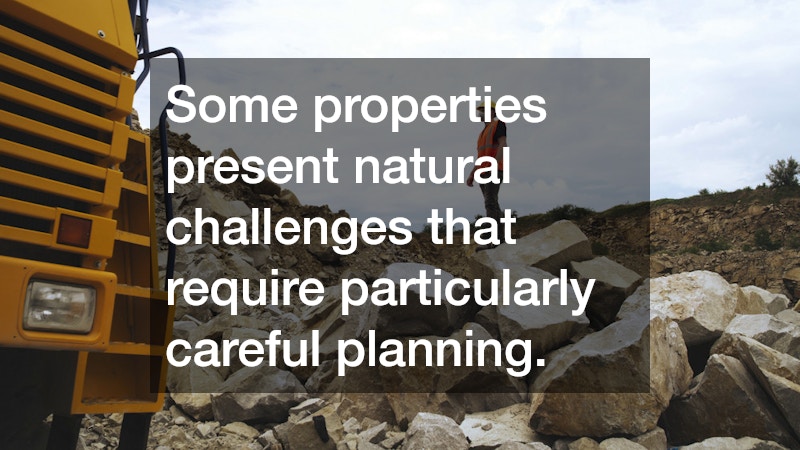
Some properties present natural challenges that require particularly careful planning. Steep slopes, uneven terrain, limited access, poor drainage, erosion, and significant elevation changes can make conventional grading methods impractical. In these situations, the contractor must adapt the scope and sequence of the work to address the property’s specific limitations.
Steep or irregular terrain may require strategic excavation and soil placement to create usable areas without unnecessarily disturbing the surrounding land. Depending on the project, grading may also need to work alongside retaining structures, erosion-control measures, or other site improvements. The objective is to create stable, functional surfaces while accounting for the forces that affect the property.
Drainage concerns can be especially important on properties where water naturally flows toward structures or neighboring areas. Grading can help establish slopes and elevations that direct runoff toward suitable drainage areas. Contractors must consider both the immediate property and how changes could affect surrounding land, particularly when water crosses property boundaries.
Successful grading requires more than simply moving soil from one location to another. It involves evaluating the property’s existing conditions, understanding the project’s objectives, and adapting construction methods to address terrain, drainage, soil, access, and other site-specific factors. A tailored approach can help create stable, functional grades that support construction while addressing the unique characteristics of the land. Working with an experienced site grading company can provide a more deliberate process for preparing different types of properties for their intended use.